
Power to Choose Texas: How to Use It (and Avoid the Traps)
Power to Choose (PowerToChoose.org) is the official plan-comparison site run by the Public Utility Commission of Texas. It’s free, it’s legit, and it lists hundreds of plans. By default, Power to Choose hides most credit plans. Click Show All Plans and they’re back at the top.
Texas Electricity Finder is not Power to Choose and isn’t part of the PUC. We’re an independent Texas company that shows a short list of simple plans from providers we’d use ourselves, priced at the usage you actually have.
Want the short version? Enter your ZIP and see the simple plans we recommend for your area.
Plans and prices change often, so we check them regularly.
- Updated:
- November 3, 2026
By Devin Krebs · Reviewed by Courtney
Key takeaways
- Power to Choose (powertochoose.org) is the PUC’s official, free plan list. Lookalike sites with similar names are not.
- The list ranks plans at one usage level, usually 1,000 kWh. A plan can look cheapest there and cost more at your real usage.
- On one real plan, using 999 kWh instead of 1,000 kWh raised the bill from $69.43 to $194.24.
- Pull your last 12 months of usage from Smart Meter Texas, then check each plan’s EFL at 500, 1,000 and 2,000 kWh.
- Screenshot the EFL when you sign up so you have proof of the plan you agreed to.
What Is Power to Choose? A Quick Overview
Power to Choose is the state’s official list of electricity plans for the parts of Texas where you pick your own electric company. The PUC runs it. It’s free for you to use.
You type in your ZIP, and it shows plans from providers that serve your address. Each plan has an average price at 500, 1,000 and 2,000 kWh, pulled from that plan’s Electricity Facts Label (EFL).

Two companies touch your power. Your utility (also called the TDU) owns the poles and wires and fixes outages. In most of the competitive market that’s Oncor, CenterPoint, AEP Texas or TNMP, and you don’t get to pick it. Your provider (the electric company) sells you the electricity and sends the bill. That’s the part you shop for. Whoever you choose, the same utility delivers your power, and its delivery charges pass through to your bill.
Power to Choose is a fine place to start. Below is how to read it so the cheapest-looking plan doesn’t end up costing you more.
Use the Real Site: Watch for Lookalikes
The official site is powertochoose.org. The Public Utility Commission of Texas calls it “the official and unbiased electric choice website of the Public Utility Commission of Texas” (powertochoose.org, checked Nov 2026). Other sites use similar names, ads and logos, and some are run by companies selling plans.
- Type powertochoose.org into your browser yourself instead of clicking an ad.
- Check the address bar before you enter your ZIP or any personal details.
- Power to Choose is free to use. You don’t pay a fee to compare plans there.
That includes us: Texas Electricity Finder is not Power to Choose and isn’t part of the PUC.
What Power to Choose Is Not:
Clearing Up Common Misconceptions
A lot of people figure that if a plan is on a state website, the state checked it out. It didn’t.
Not a stamp of approval. Providers list plans that meet the basic filing rules. The PUC doesn’t rank plans by value or tell you which one is good.
Not every plan or provider. Listing is voluntary, so some providers and some of their plans aren’t there.
Not sorted by what you’ll pay. The default sort uses each plan’s average price at one usage level, usually 1,000 kWh. Plans built to look cheap at exactly that point are hidden by default, but click Show All Plans and they’re back at the top. Your bill depends on what you really use, month by month.
None of that makes the site bad. It’s a list, not an advisor, and the fine print is on you.
Even Power to Choose wants you to be cautious
The site says so in its own words: “the PUCT does not endorse or approve any third-party products, services, or opinions.” We agree with its advice: read the Electricity Facts Label before you sign. Every plan has one, and it’s where the details live.

How to Use Power to Choose Effectively
If you’d rather shop there yourself, here’s how to do it without getting burned.
 Know your usage first. Get your last 12 months of kWh for free at Smart Meter Texas (smartmetertexas.com). You’ll need your ESIID or meter number from a bill. Note your low month and your high month, not just the average.
Keep the fixed-rate filter on. Power to Choose shows fixed-rate plans by default. Leave variable-rate plans off unless you plan to watch the price every month.
Open the EFL for every plan you like. Look at the price at 500, 1,000 and 2,000 kWh. If the three numbers swing a lot, there’s a credit or fee behind it.
Check the provider. Look at the PUC complaint scorecard and recent reviews.
Confirm with the provider before you sign. Prices change, so make sure the EFL you read is the one you’re enrolling in.
Screenshot the EFL when you sign up. Save the EFL, or screenshot it, on the day you enroll, with the date and EFL version showing. If your bill doesn’t match, that’s your proof of the plan you agreed to.
Pro tip: If that sounds like a lot, our simple plans are already checked for these traps.
Shop Trusted Plans Now
What the EFL Tells You (With a Real Example)
Every plan has an Electricity Facts Label. Here’s what to look at:
Average price at 500, 1,000 and 2,000 kWh. These three prices already include everything: energy, base charge, delivery charges and credits. If the 1,000 number is far lower than the other two, a bill credit is doing the work.
Energy charge. What the provider charges per kWh for the electricity itself.
Base charge. A flat monthly fee you pay no matter how much you use.
Delivery charges. Your utility’s charges (Oncor, CenterPoint, AEP Texas or TNMP), passed through at cost. Every provider in your area pays the same ones.
Term and ETF. How many months you’re locked in and what it costs to leave early.
A real example: what 1 kWh can cost you
Here’s one real plan’s fact label, worked out in dollars. We used a real 12-month bill-credit plan in the Oncor area (EFL dated October 2026). It has a $125 credit in any month you use 1,000 kWh or more.| Monthly use | Energy charge | Oncor delivery | Credit | Your bill |
|---|---|---|---|---|
| 999 kWh | $121.58 | $72.66 | none | $194.24 |
| 1,000 kWh | $121.70 | $72.73 | −$125.00 | $69.43 |
| 1,200 kWh | $146.04 | $86.47 | −$125.00 | $107.51 |
Risks to Look Out for on Power to Choose
Here’s what to watch for when choosing a plan:
Time of Use Plans
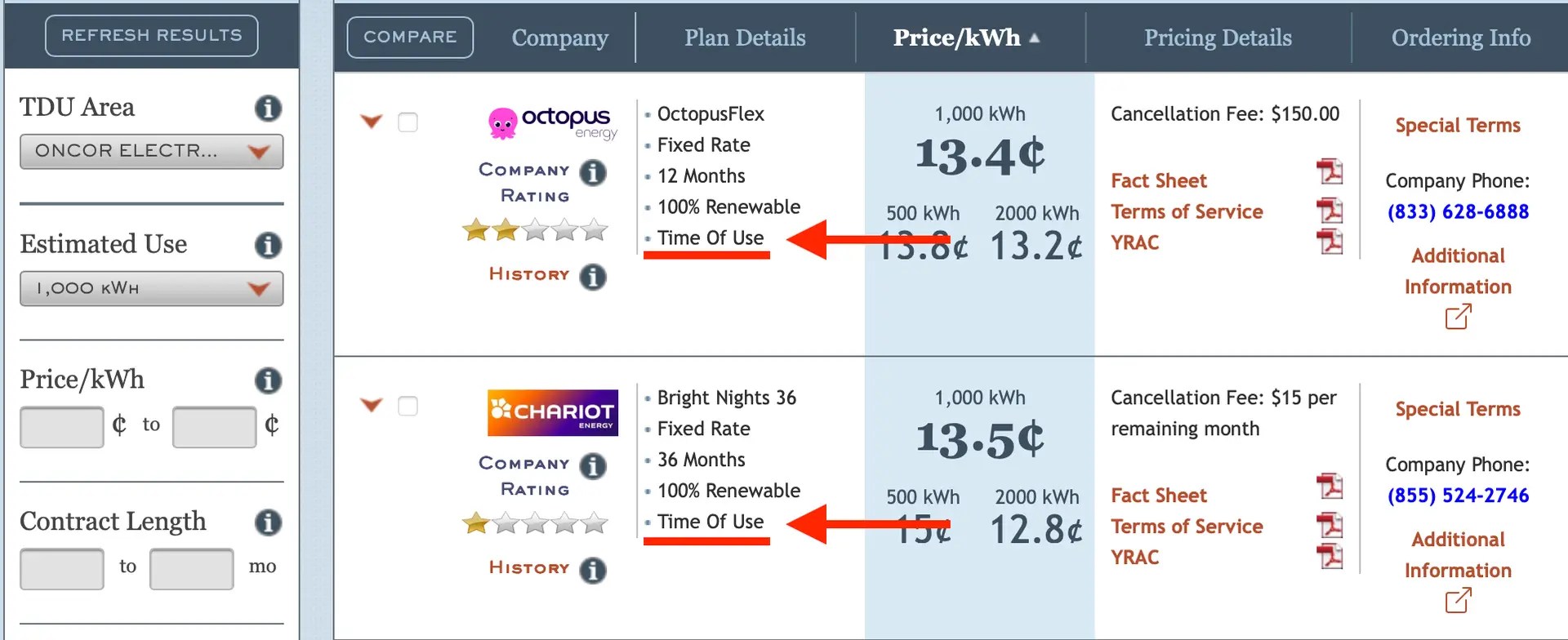
Time-of-use plans charge less during certain hours, often nights or weekends, and more the rest of the day. The low price you see assumes a lot of your usage lands in the cheap hours.
Most households run the AC, cook and do laundry in the afternoon and evening. If that’s you, a time-of-use plan can cost more than a simple fixed-rate plan. Check the EFL for the exact hours and what you pay outside them.

Smart Plans
Smart thermostat plans give you a monthly discount for connecting an approved thermostat to the provider. In return, the provider can adjust your thermostat during peak demand, which in a Texas summer usually means warmer.
Read the rules on keeping the discount. If you disconnect the thermostat, swap devices or override too many adjustments, you can lose it. These plans can work if you’re fine handing over some control.
"Sustainable" Plans
Some plans make you buy carbon credits to enroll. One example we found: Just Energy’s “Sustainable Days Bundle” EFLs list a required one-time GoodBundle setup and carbon offset purchase of $49.99, which includes 2,000 lbs of carbon credits. The EFL counts only 1/12 of that fee in its average prices, so the advertised price looks lower than what you pay when you sign up.
💡 Insider tip: Amigo Energy and Tara Energy are brands of Just Energy, so three names on the list can be one company. GoodBundle says its electricity perks work only with those three providers.
What Are Carbon Credits?
A carbon credit pays for a project that cuts or removes carbon somewhere else, like planting trees or capturing methane. Buying them is meant to balance out emissions from your own use. It doesn’t change where your electricity comes from.
Our Take on Sustainable Plans
Paying for credits doesn’t lower your bill or how much power you use. If renewable energy matters to you, compare it with a 100% renewable plan that has no add-on fee.


💡 Did You Know?
More PowerToChoose.org Risks to Dodge
Odd Term Contracts

Unknown Providers

- Not every credit starts at 1,000 kWh. Some start at 500, some at 2,000, and some stop paying once you go over a cap. Find the exact range on the EFL.
- Free nights means free energy charges, not a free bill. Delivery charges still apply, and some plans won’t take homes with an EV, battery or solar.
- The listing is a summary. If it and the EFL don’t match, the EFL is what you’re signing, so keep a copy.
- Some fees aren’t on the EFL at all. Skim the Terms of Service for late, disconnection-notice and meter fees.
Even with the default filters, plans with time windows, add-on fees or very short terms can land near the top, and Show All Plans brings the credit plans back up with them. They post a low number at one usage level. They can work if you watch your usage closely every month. Most people just want a fair price they don’t have to babysit.
Looking for a Power to Choose Alternative?
A Smarter, Simpler Way to Shop
We started Texas Electricity Finder because shopping for power got harder than it should be. We’d sort a list, find a great price, then read the EFL and find the credit, the fee or the time window.
So we do the reading for you.
✅ Real price at your usage. We show what a plan costs at the usage you actually have, delivery charges included, not just at 1,000 kWh.
✅ Simple plans first. We put plain fixed-rate plans at the top. No bill credits, time-of-use windows or teaser pricing.
✅ Providers we’d use ourselves. If we wouldn’t sign up for it, we don’t recommend it.
Start by checking today’s Texas electricity rates, or enter your ZIP above. A few providers we’d use ourselves: Rhythm Energy, Chariot Energy and Gexa Energy. Before you sign with anyone, check the PUC complaint scorecard (October 2026 edition).✅ A short list. We don’t show every plan. We show the few we think are worth it.
Switch to a Trusted Plan Today
Skip the guesswork.
Enter your ZIP and see our best simple plan for your area, priced at real usage.
Common Questions about Power to Choose
These are the questions Texans ask us most.
Is Power to Choose legit? +
Yes. It’s the official site run by the Public Utility Commission of Texas. The plans are real offers from licensed providers. Being listed just doesn’t mean a plan is a good deal.
Is Power to Choose free? +
Yes. It costs nothing to search or compare, and you don’t pay a fee to sign up through it.
Why does the cheapest plan on the list end up costing more? +
The ranking uses one usage level, usually 1,000 kWh. Bill-credit plans are hidden by default, but click Show All Plans and many of the top spots go to plans with a credit that only kicks in at or above that point. Use a bit less, like 999 kWh, and you lose the credit and the price jumps. Check the price at 500 and 2,000 kWh on the EFL too, and compare it with your own usage.
Can I switch without paying a cancellation fee? +
Yes, if you switch in the last 14 days before your contract ends. Before that, check the early termination fee (ETF) on your EFL or contract. Moving? State rules say your provider can’t charge an early termination fee because you moved, as long as you give a forwarding address and, if asked, proof you no longer live at the old address.
Does the state endorse the plans on Power to Choose? +
No. The PUC runs the site but doesn’t endorse or rank plans by quality.
Are all providers on Power to Choose? +
No. Listing is voluntary, and some providers list only some plans or none.
Are the providers listed there good? +
Some are, some aren’t. Look up the provider on the PUC’s complaint scorecard and read recent reviews before you sign.
Is Power to Choose easy to use? +
Searching is easy. Picking well takes reading the EFL, which is where most people get tripped up.
Final Thoughts on Power to Choose
Power to Choose is the state’s official list, and it’s worth knowing how to use. Just don’t trust the top of the list on its own. Know your usage, read the EFL, and check the price at 500 and 2,000 kWh, not only 1,000.
If you’d rather skip that, start with our simple plans. Questions? Email us at contact@texaselectricityfinder.com.
Get Personalized Help Switch to a Trusted Plan Today
Written by Devin Krebs
Devin runs Texas Electricity Finder. He reads the Electricity Facts Labels behind the plans we list and built our short list around one rule: if he wouldn’t sign up for a plan himself, we don’t recommend it.
Reviewed by Courtney, Head of Content
Courtney checks every guide against current EFLs and state rules before it goes live, and rechecks the numbers when prices change.
Reviewed Nov 2026
How we make money
We recommend a short list of partner providers, and those providers pay us. That’s how we keep this site free, and we hold their plans to the same EFL check as everyone else’s.
If you found this helpful and think others could benefit from reading it, share it!